Talk That Transforms: The Art of Conversations That Change Everything
The Art of Conversations That Change Everything. There’s a conversation I still think about, years later. It wasn’t a TED talk. It wasn’t a therapy session. It was a ten-minute exchange with a mentor who asked me one question I wasn’t prepared to answer honestly. By the time I left the room, I was a slightly different person — not dramatically, but permanently. That’s the power of talk that transforms.
Most conversations are transactions. We exchange information, make plans, confirm what we already believe. We talk at people and listen for gaps where we can speak next.
Transformative talk is different. It creates something that didn’t exist before — a new understanding, a shift in perspective, a crack in a belief we thought was load-bearing. It doesn’t need to be long, loud, or led by an expert. It just needs to be real.
Research in psychology points to a few qualities that separate ordinary conversations from transformative ones:
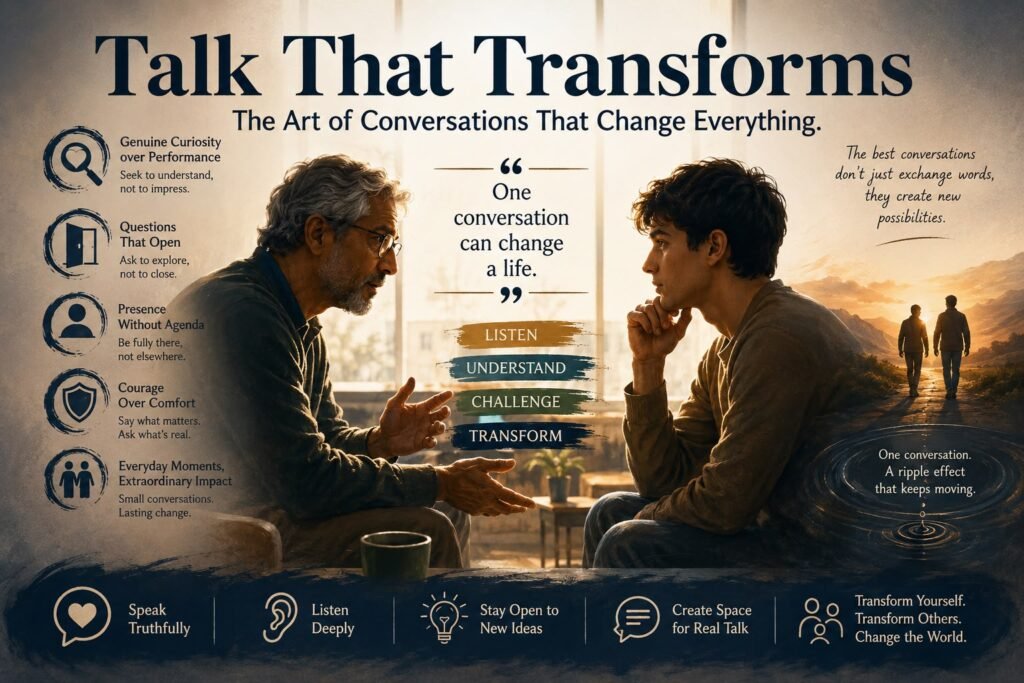
Genuine curiosity over performance. The speaker isn’t trying to impress — they’re trying to understand. That energy is felt immediately.
Questions that open, not close. “What do you mean by that?” opens a door. “So you’re saying X, right?” shuts one.
Presence without agenda. When someone is fully in the conversation — not rehearsing their next point — the other person feels safe enough to go deeper. The most transformative conversations often involve someone kindly refusing to let you off the hook.
When you ask a question you genuinely don’t know the answer to, you open yourself to being changed by the response. When you listen without already knowing what you think, you remain permeable to new ideas. The best communicators aren’t great speakers — they’re great receivers.
The Courage It Requires
Transformative talk isn’t always comfortable. Sometimes it means:
Saying the thing no one in the room is willing to say.
Asking someone why they really made a decision, when the surface answer isn’t the true one.
Admitting uncertainty in a world that rewards confidence.
Staying in a difficult conversation instead of escaping into small talk.
This kind of talk asks something of us. It requires that we show up as a person, not just a role. That we risk being changed, challenged, or wrong.
Most people avoid it. That’s why it’s rare, and why it matters so much when it happens.
Everyday Moments, Extraordinary Impact
You don’t need a stage to have a transformative conversation. In fact, the most powerful ones rarely happen on stages.
They happen at kitchen tables. In car rides. In the five minutes after a meeting when most people have left the room. They happen when someone pauses long enough to ask, “How are you, really?” — and actually waits for the answer.
The parent who asks their teenager what they’re afraid of, and listens without fixing. The colleague who names the tension everyone else pretends not to notice. The friend who reflects back something you said about yourself that you hadn’t noticed you believed.
These are small moments. But small moments, compounded, are how people change.
Becoming Someone Whose Words Matter
If you want to have talks that transform — in your relationships, your work, your communities — the place to start isn’t your vocabulary or your presence or your delivery. It’s your intention.
Ask yourself before a conversation: Am I here to be heard, or to understand? Am I here to confirm what I know, or to discover what I don’t?
Then practice the hardest thing in human communication: being quiet long enough for something true to emerge.
The words will follow. And some of them — the ones you can’t predict, the ones that surprise even you — will be exactly what someone needed to hear.
Talk can inform. It can entertain. It can persuade. But at its best — honest, curious, courageous, and fully present — it transforms. And once a person is transformed by a conversation, they carry it forward. They have it with someone else. The ripple keeps moving.
That’s the real power of words. Not the ones we craft carefully, but the ones we speak truthfully.